Sunday, 15 January 2012

Kanheri Caves - Mumbai, India


Kanheri caves are located inside the Sanjay Gandhi National park , in borivali.
Sanjay Gandhi National Park is the largest National Park in the world within city limits. More details of the park can be found in my  dedicated National park post.The caves are at 6kms from the National park Main gate.


                    The caves portrays the buddhist influence in india with respect to art, culture and literature.These caves are carved out of mammoth basalt rocks, you could see the chiseled rock stairs, prayer halls, darbar halls etc.Buddhism was introduced at Sopara which was once the capital of North Konkan way back in the 3rd Century BC. Since then, Kanheri was used as a learning centre for the Buddhism followers. The cutting , chiseling of the hill and making these monasteries continued till 9th century AD.


Darbar Hall

Add caption


I think this would be the largest buddhist monastry remnants in terms of the cave counts, as much as around 110 caves are carved out in kanheri, to explore all ,needs a couple of days expedition.
There are numerous inscriptions , epigraphs found at kanheri. Decoding was not my cup of tea.


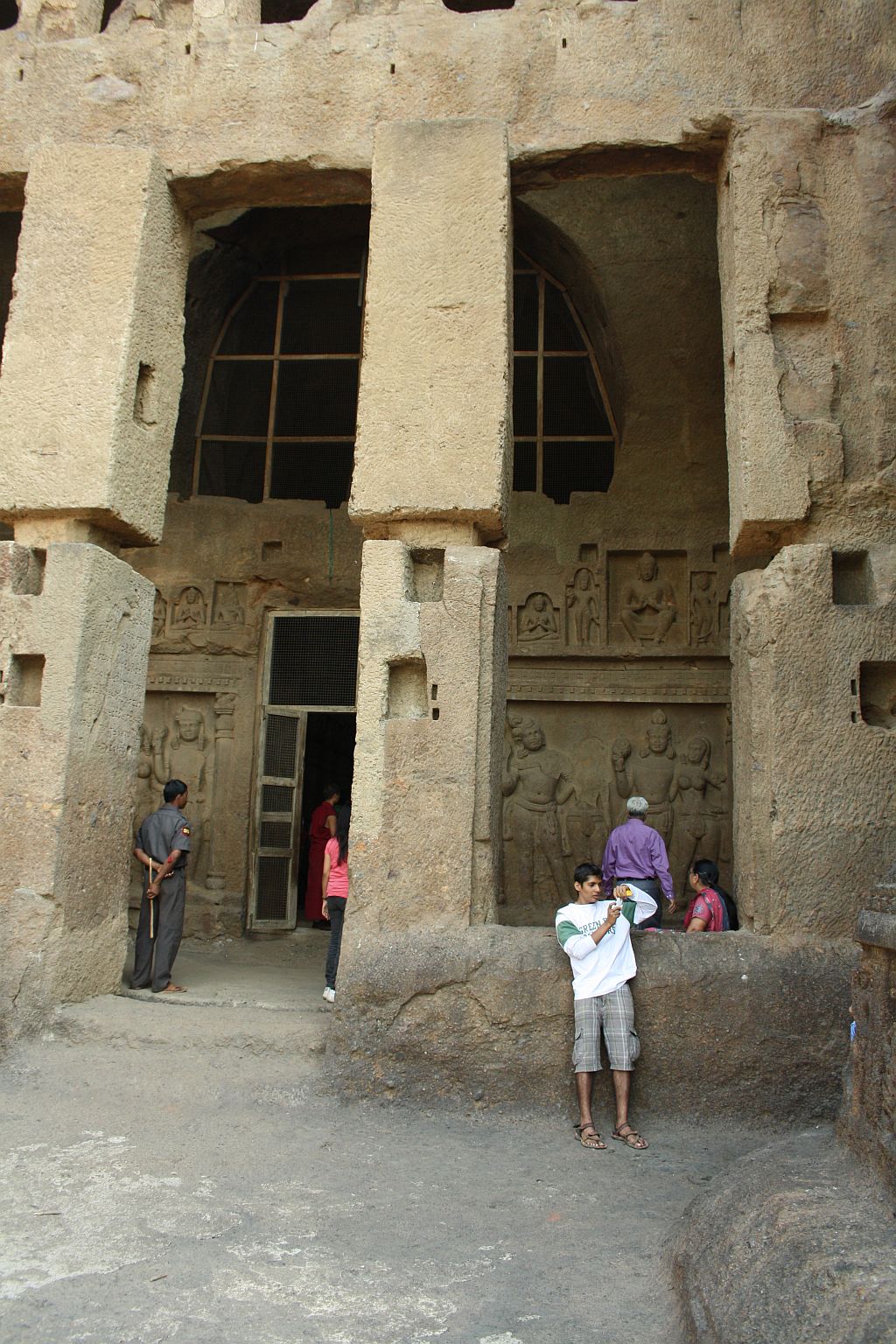


Vihara - Prayer hall
                                                         
Vihara- prayer hall.
                                                                        
Thanks to the Archeological Survey of India for maintaining such a spectacular piece of history.
Vihara(Monastery) - prayer hall. We could still see spate of buddhist followers visiting the place and offering prayer at the hall.

View of the national park from the apex
                                               
Unfinished buddha painting
                                                                
Chiseled rock cut stairs to the cliff top


Post monsoons, greener surroundings and small water falls adds more elegance to the place.
The visitors are prohibited into the national park premises after 6pm, as the night crawlers and predators rules the nocturness.
I was embarassed to know, there are thousands of people, may be more, residing in mumbai, who have not yet visisted Kanheri.

How to reach there:
Visitors need to pay an entry fee once at the entrance of the park and another at the entrance of the kanheri caves.
Can rent a bicycle for Rs.100 per hour, which has been started recently to promote pollution free environment.Transport by bus to the caves is available every hour.
Nearest Railway / Bus Station: Borivali

Thursday, 16 October 2008

Blegny Mine - Liege, Belgium

The coalfields of Wallonia(the french speaking province in Belgium) were once the most productive in western Europe almost for 8 centuries, but in the 1970s there was a spate of closure of these mines,as the precious black thing became uneconomical to extract.


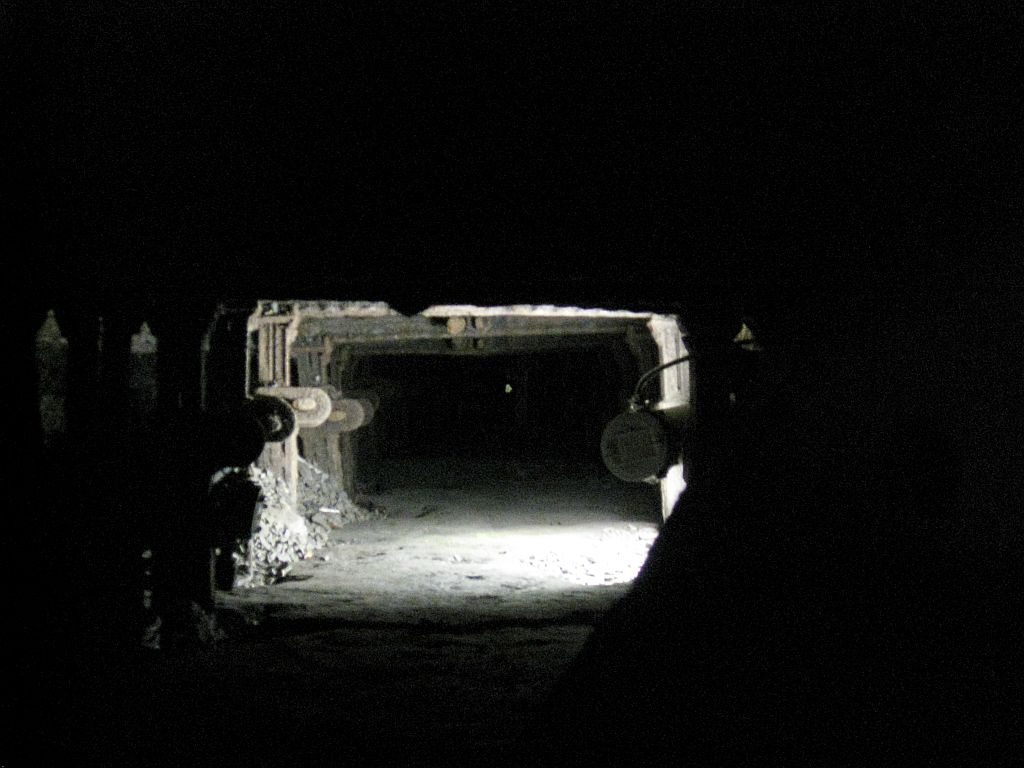
The Blegny Mine, near Liège in Brussel, was one of the last to cease production (in 1980), but the authorities decided to preserve it so that future generations could appreciate the physically punishing work the miners had to endure, and the huge contribution they made to Belgium’s prosperity.Blegny is the only mine in continental Europe where you can descend to the underground  at a depth of 30 and 60 metres.
English speaking guides and audio guides also are easily available at the ticket counters for assistance through out the trip.


Visitors have to wear all safety gears before going down, a video documentary also is shown abt the evolution of coal and its life cycle.
The guide once after the documentary, discusses about the do's and dont's, further takes small groups one after another in the miners lift down to 30m and then further to 60m.
Some of thedrills are still in working condition and the working demo is also shown.
Every nitty gritty about the process can also be founddisplayed in form of charts and diagrams on every trails.
The trip literally makes us ponder about the hardships and efforts faced by the coal miners amidst suffocation , such far down underground with no light and air.


Saturday, 27 September 2008

Giethoorn, The Venice of Holland

Giethoorn - The Netherlands

Giethoorn is a village in the Dutch province of Overijssel, known in the Netherlands as Venice of the North , some times also known as the Venice of the Netherland, though it is debatable topic when you think about Amsterdam.
All transport in this location are done by water ways over a spate of canals.There were no roads in the earlier times, but these days there is a cycling path parallel with most of the canals.


What i could understand from the villagers is, the canals/ lakes are formed as a result of peat digging.
Peat is a brown, soil-like material characteristic of boggy, acid ground, consisting of partly decomposed vegetable matter (courtesy : Internet).
The excavation of peat by the villagers led to these canals. This village used to rest on the mine of peat.
Peat is pretty soft and compressible. Under pressure, water in the peat is oozed out, further upon drying peat can be used as fuel.
Peat is harvested as an important source of fuel in certain parts of the world. In countries, where there are scarcity of trees, peat is traditionally used for cooking and domestic heating.

Activities:
  • Rent a bike(bi-cycle) and pedal along the canals, where ever the cycling path leads you. 
  • Rent a motor boat / row boat
  • Pit stop at good pub, if its a sunny weather, then perfect, dive into the world of booze..
  • Shop, if you are an antique lover or souvenir collector.
It is literaly a paradise, full of canals, all lustic green trees overshadowing, with small cafes, pubs,souvenir shops seen in the nooks of the village.It was a wonder to see the dutch canal village with no streets at all. These canals also leads you to a lake as well.